All brightness above
A frosty morning, a Christmas album, a brass band, and an extremely festive edition of the Village News
Hi, how are you doing?
Welcome to the December edition of Witness Marks. If you’re new here and would like a quick tour of the village (and the newsletter), start by reading this post here.
Witness Marks goes out on or around the 15th of each month; in between times you can find me chatting away in Substack Notes. The first part is free, while the second part, the Village News, sits below a paywall. A subscription costs £3.50 a month if you pay via Substack Desktop (Apple add a bit on top if you pay via the app). If that feels like a stretch, send me a private message. No questions asked.
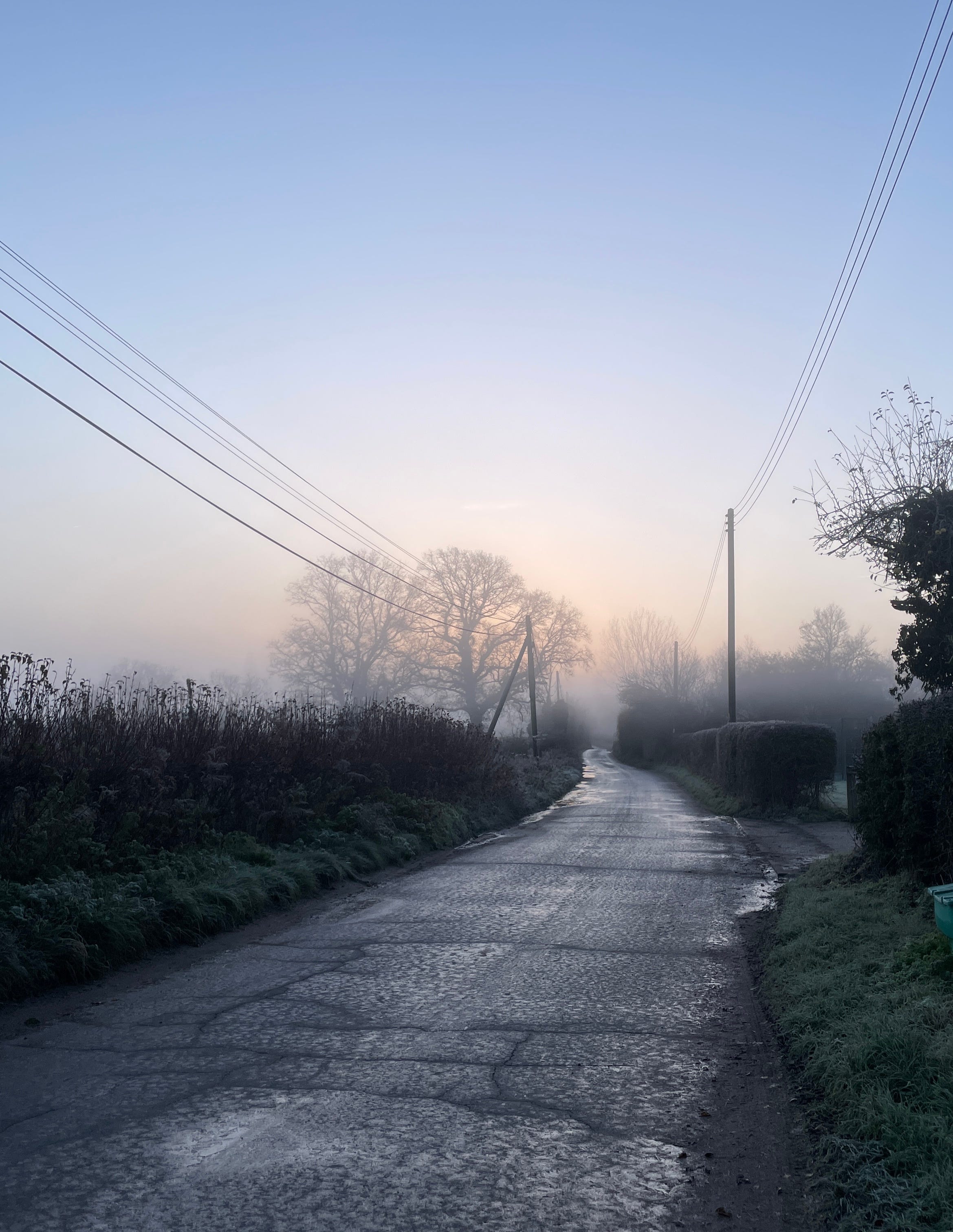
I set out for a run on a day that, despite all the recent wet weather, began in mist and ice. Minus one, and thank the cold, blue heavens for it: closing in on midwinter and only the second proper frost we’ve had. November should be frosty; December should hold us in an iron grip. The bulbs sleeping in the ground need cold in order to wake up; the wildflowers need to be told when to rest. The soil in the fields and gardens needs frost to break up the clods and to kill off pathogens before next year.
Turning off the icy lane I ran on muddy field paths and tracks which the overnight frost had hardened. I had gloves on, and once my pace was up and my breathing had stabilised I felt fine. Mist cloaked the trees and the wet, low-lying fields near the river, and the air felt fresh and still. Here and there, especially in the newly bare branches of poplars, balls of mistletoe were revealed like huge, airy baubles: most were in the same tree as last year and the year before that, back and back to before I came here.
Mistletoe, a parasitic plant which is almost impossible to propagate by hand, is becoming more common, which is interesting given that it’s increasingly harvested in bulk to be sold in Christmas markets. The reason is thought to be connected, in a roundabout way, to climate change: a little bird called the blackcap, which was once a spring and summer visitor, is overwintering here in slowly growing numbers due to our milder weather, and mistletoe berries are one of its favourite foods. Blackcaps eat the pulp but wipe the sticky seeds from their beaks on to twigs and branches, and some of those seeds will germinate. Mistle thrushes (named for their love of the plant) and their visiting cousins the redwings and fieldfares also eat mistletoe berries, but they swallow them whole; the seeds do pass through in their droppings and germinate, but, it seems, at a much lower rate than those fastidiously wiped from blackcaps’ bills.
Now that Suffolk’s woods and copses are unclothed the square flint towers of the village churches can more easily be glimpsed across the fields. In winter it’s clear how many of the older tracks and field paths align with them: ancient arteries of faith and duty, landmarks for travellers moving from place to place.
As I ran the light rose and colour crept into the world. The beet campaign is still underway and I passed a huge red harvester guarding a vast mountain of dirty roots ready to be loaded into lorries later in the day. Only the pea harvesters are bigger, sometimes requiring escort vehicles on the A-roads as they move from farm to farm. On the short stretch of road I take between fields the tarmac was thick with mud from the tractors and trailers going in and out, and I thought of the neighbour who complained to me, last year, about the mud it left on his sports car. I don’t think I managed a particularly eloquent reply, but I suspect the look on my face was enough.
The river was high but back in its channel after the recent flood, and on the wet watermeadows the scrapes recently dug for wintering waders were wide and silver. As I came back into the village the ice had vanished from the lanes and robins and great tits were carolling in a weak winter sun. The ditch beside the road gurgled with water; the world was “all brightness above and glittering reflections below,” as Adrian Bell wrote of a similar Suffolk morning in December 1956: “Full dykes flashed: half-flooded marshlands seemed littered with flakes from the sky.”
Back at my cottage I scattered mealworms for the tribe of sparrows sitting hopefully in the winter jasmine. They were squabbling over them before I’d even closed the door.

As most of you know, this year I launched a free nature connection app for people in Britain and Ireland. It’s called Encounter and you can find it in the usual places: it is a guided nature journal that lives in your phone, and I think it’s absolutely bloody marvellous. Anyway, we’ve just announced our first partnership, something of which I am burstingly proud. It’s with Meaningful Planet, an ethical mobile phone network that restores nature by donating 10% of every bill to environmental restoration projects via The Wildlife Trusts. They run on the EE network and offer unlimited calls and texts, UK support and free EU roaming. Isn’t that cool?
And you know what’s even cooler? If you sign up to Meaningful Planet via our special link or by pressing the button you’ll get a 10% discount on your bills for life, and you’ll also be supporting Encounter with every call. If you’re out of contract, or soon to be, why not check them out and see what they offer? It’s a nice feeling, knowing that your money is doing good work in the world. 👇🏼
And if you’re in Britain or Ireland and haven’t downloaded Encounter already, may I encourage you to do so? We’ll be helping our users stay connected to nature over Christmas, with ideas and inspiration from 12 Days Wild to the New Year Plant Hunt. Search ‘Encounter Nature’ wherever you get your apps – it’s free!
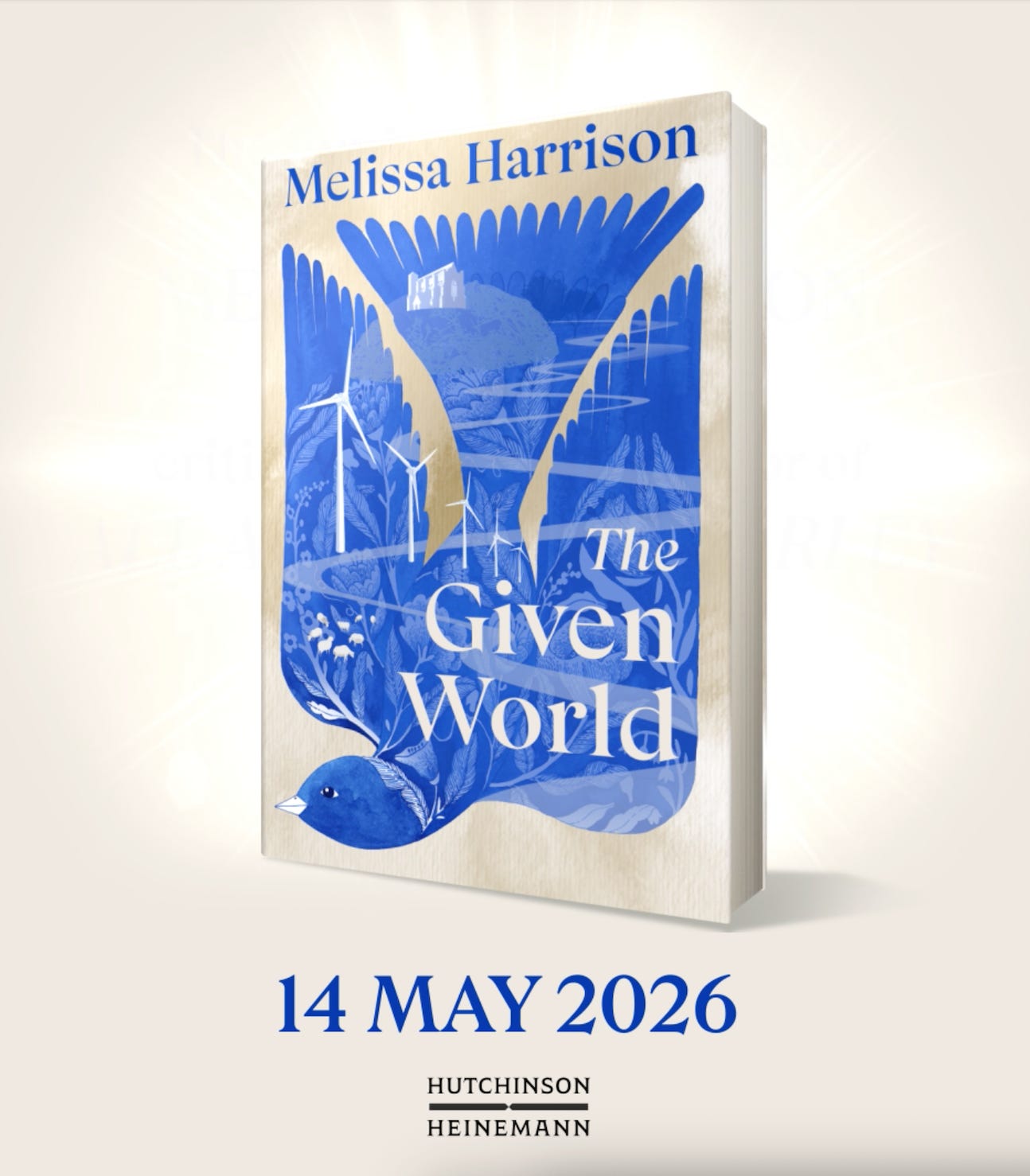
Proofs of my new novel, The Given World, are still going out into the world and being read by friends and peers. Slowly it is becoming separate from me: instead of a place I go to in my head, alone, it is becoming a landscape explored by other people, and a product, too, that in May it will be possible to buy. I need to let go of some of my beliefs about it – including my attachment to the parts that never came to fruition but still live inside me as failures only I know about – and instead start to see it through other people’s eyes.
A couple of recent comments have truly floored me. Amy Liptrot has called it “an Under Milk Wood for the twenty-first century”, while Francis Spufford has said it’s “a brilliantly acute social portrait of English rural life… the best piece of serious fiction l’ve read this year”. I keep looking at these comments out of the corner of my eye, not quite sure if I can believe them yet.
Meanwhile, on Substack Notes I was given a valuable opportunity to rough out an ‘elevator pitch’ by stepfanie tyler, who asked me what it was about. “Honestly? Fuck knows,” was my first, flippant reply. “It’s my fourth and I kind of let it have its head. There’s a village in it, and a priory, and a river that may or may not be animate. Oh, and some Tarot. And a dying woman, and Weyland the Smith, and a sad farmer called Alan”. I then spent three days feeling disappointed with myself for undermining my own project, before trying again: “I guess it’s also a kind of fable about the Promethean-patriarchal world view and its attendant thanatophobia and how it might be countered by older and opposing energies on a beautiful but dying planet.” Still not right, but maybe closer to the truth.
I suspect I won’t really know what it’s about until May 14th, when it finds its readers. It’s only then that the process of meaning-making will be complete.

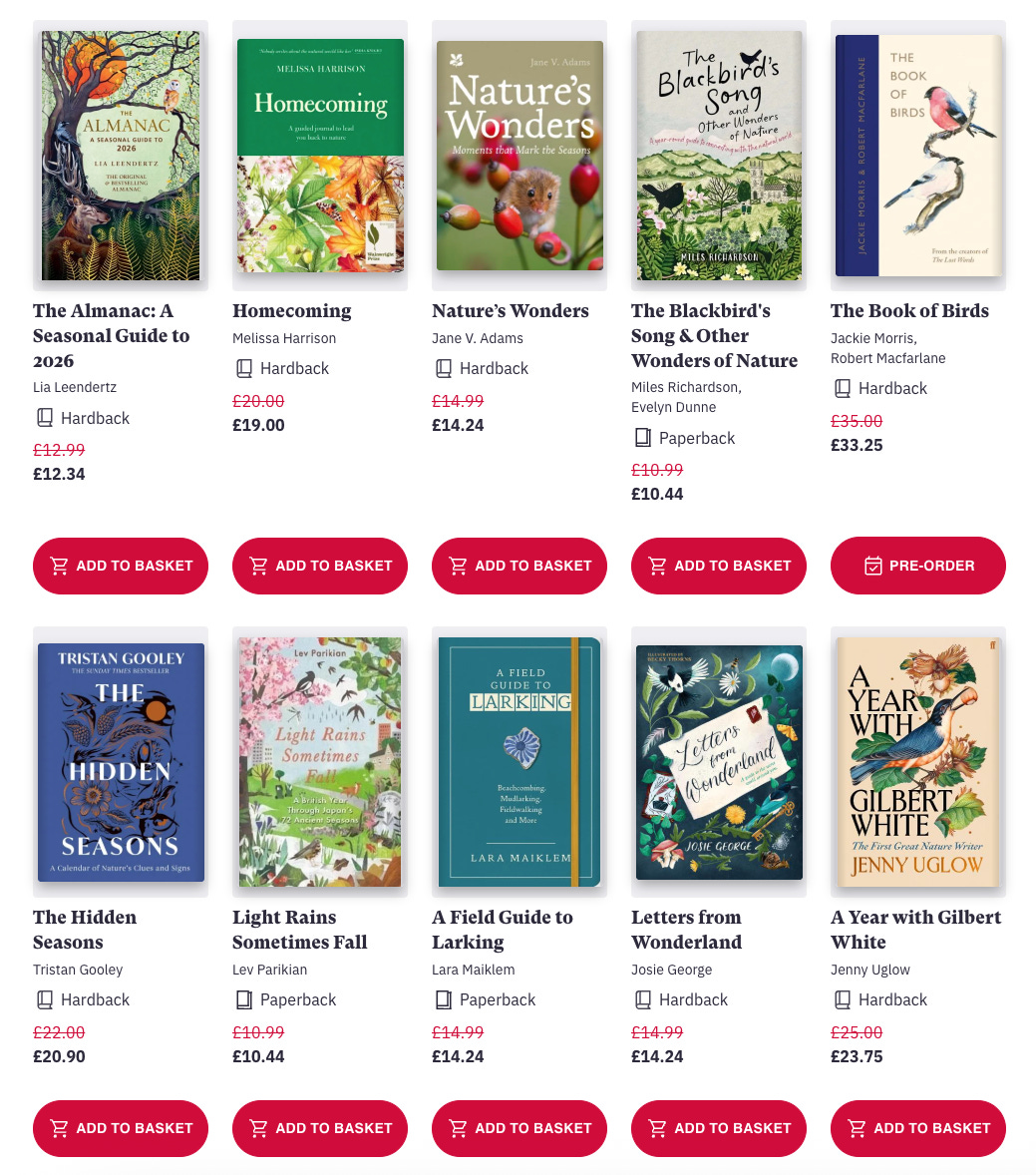
Do you still have any Christmas presents left to buy? Perhaps you’d like something good to read over the festive period? I’ve made a list of 31 lovely books about nature, noticing and the seasons, all of which would make great gifts. You can find them all at Bookshop.org, which supports bricks-and-mortar bookshops with every sale:
Three things that aren’t on screens
Each month I collect together three things that have interested me, for good or ill, and which can be found in the world beyond your phone or laptop:
👉🏼 A nice thing: The Norfolk composer and performer Laura Cannell - Musician Being has just released a Christmas album, and it’s just as dark and strange and atmospheric as you’d expect. If you’re happy with Noddy Holder and ‘Last Christmas’, more power to you, but if midwinter to you is more about ice and ghosts and ancient, half-pagan songs, ‘Brightly Shone the Moon’ is what you need. “This is an album not for the party or the tree decorations, but one that carries you, hauntingly, through the passing of time,” says the Guardian. Those who believe in supporting artists can buy it on CD or as a digital download on Bandcamp, though it’s also on Spotify if you really must.
👉🏼 An interesting thing: Strictly speaking, a podcast is probably ‘on a screen’ – but you can listen to them while out walking, so I’m including one here. Anatomy of a Cancellation is an exploration of the furore surrounding Kate Clanchy’s book, Some Kids I Taught And What They Taught Me. I remember watching this unfold on Twitter, and as more and more people self-righteously or sometimes gleefully picked a side I had a growing feeling of absolute terror. Anyone who says that someone hasn’t been cancelled just because they still have a job/column/book deal is being strategically disingenuous: to ostracise or cast another human out ‘beyond the pale’ is an incredibly serious thing to do. Kate is here on Substack for those who want to know more.
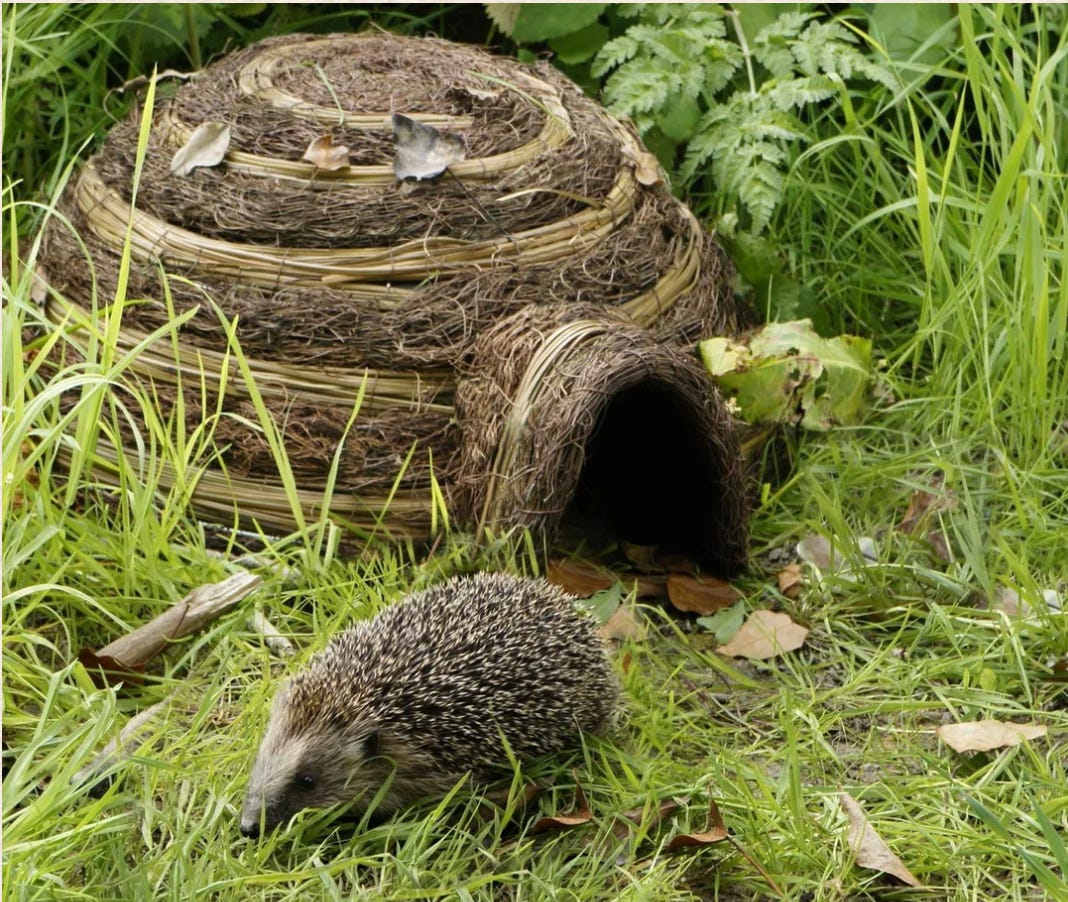
👉🏼 A thing that made me go ‘hmm’: This week I learned that there are some kinds of hedgehog house (below) that can actually kill hedgehogs: amazing work, humans, give yourselves a slow handclap. If you’d like to buy a Christmas present for a wildlife gardener (or for yourself), Kate Bradbury has rounded up the best (non-lethal) hog houses, bird boxes, bee hotels, swift bricks and bat boxes: the ones that will stand up to the weather and actually help wildlife rather than just making you look like a good person. Her excellent list can be found here.
I went to the Christmas brass band concert at our village church, and it was wonderful. The programme began with a medley of 22 festive numbers and moved on to ‘Frosty the Snowman’, ‘The Coventry Carol, ‘Gaudete’, ‘Stop The Cavalry’, ‘In Dulce Jubilo’, ‘Mistletoe and Wine’ and more. There were traditional carols for us to sing along with, too (in all their weirdness: ‘veiled in flesh the godhead see’ and ‘lo, he abhors not the virgin’s womb’ etc) a raffle (which we call a ‘draw’ here in Suffolk), and home-made mince pies handed around in the interval. It was perfect: the ladybirds that hibernate every year in the church window woke up and flew about, there was confusion about how many verses of ‘O Come, All Ye Faithful’ we were supposed to sing, the musical director made a fart joke (bass trombone-related) and told an off-colour story about sheep-shagging despite the new lady vicar being in one of the pews, and ‘Hark the Herald Angels’ was pitched, as it always, always is, just a little bit too high.
Please enjoy this recording I made of the brass band playing ‘The Christmas Song’, commonly known as ‘Chestnuts Roasting on an Open Fire’, co-written in 1944 by Mel Tormé during a boiling hot summer in Los Angeles. I would have saved it for the Village News, but I wanted everyone to be able to enjoy it. Isn’t it wonderful?
That’s it for the first, free part of this issue of Witness Marks. Below the paywall you’ll find the Village News, including: Viagra mystery, renegade choir, a ‘blue blob’ in the Nativity, the battle of the pub decorations and accidental egg glut. If you’ve ever longed for a life in the country, it’s for you.
If you don’t want to subscribe but you’d still like to support my various endeavours, you can leave me a tip by going here. Thank you – and merry Christmas to you, wherever you are!
Until next year –